
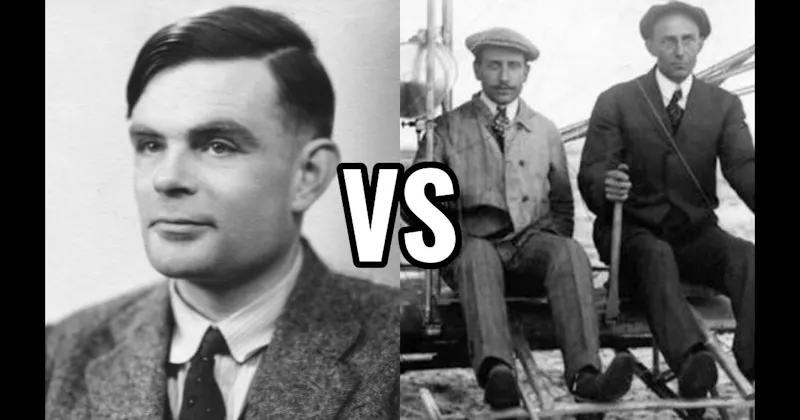
Alan Turing vs Wright Brothers
Wright Brothers leads with 54% of votes
See full Inventor rankings →Pick Your Favorite
VS
Your GOAT List
The Real Debate
Alan Turing revolutionized computing and artificial intelligence, while the Wright Brothers launched the era of aviation with their first powered flight. Turing's work whispers secrets of codes and abstract computations, contrasting sharply with the roar of the Wright Brothers' airplanes slicing through the skies. This battle pitches Turing's cerebral silence against the visceral, engine-driven tumult of the Wrights, engaging fans who debate whether the mind's frontier or the sky's the limit holds greater sway over our progress. It's a contest of thrilling intellect versus breathtaking innovation. Dive into the debate and decide: will you fly with the Wrights or decode the future with Turing?
🔥 Fan Takes
How Fans Are Voting
In this battle:
Fans currently prefer Wright Brothers over Alan Turing when it comes to the greatest Inventors of all time. In head-to-head matchups, fans pick Wright Brothers 54.5% of the time over Alan Turing.
Across all battles:
Wright Brothers win rate: 44.3%
Alan Turing win rate: 36.7%
Fan FAQs
Why is this matchup such a big debate in the league for greatest inventors?
This face-off pits the physical against the theoretical. On one side, you’ve got the Wright Brothers who created something you can touch and see soaring in the skies. On the other, Alan Turing, whose ideas laid the groundwork for the digital age. Both have massive followings who deeply admire the distinct nature of their contributions.
What's so special about Alan Turing that keeps him competitive against the Wright Brothers?
Alan Turing's legacy in computing just can't be ignored. He's considered the father of theoretical computer science and artificial intelligence. Many fans resonate with his story of triumph and tragedy, particularly how his work was pivotal during wartime and yet he faced personal battles that tug at the heartstrings.
Why are the Wright Brothers leading over Alan Turing in the Greatest Inventors of All Time league?
Fans really appreciate how the Wright Brothers literally lifted humanity off the ground with their invention of the airplane. Their breakthrough has a tangible, daily impact on how we connect globally, which might be swaying more votes their way compared to Turing's more conceptual, though critical, contributions to computing.